
What’s New?
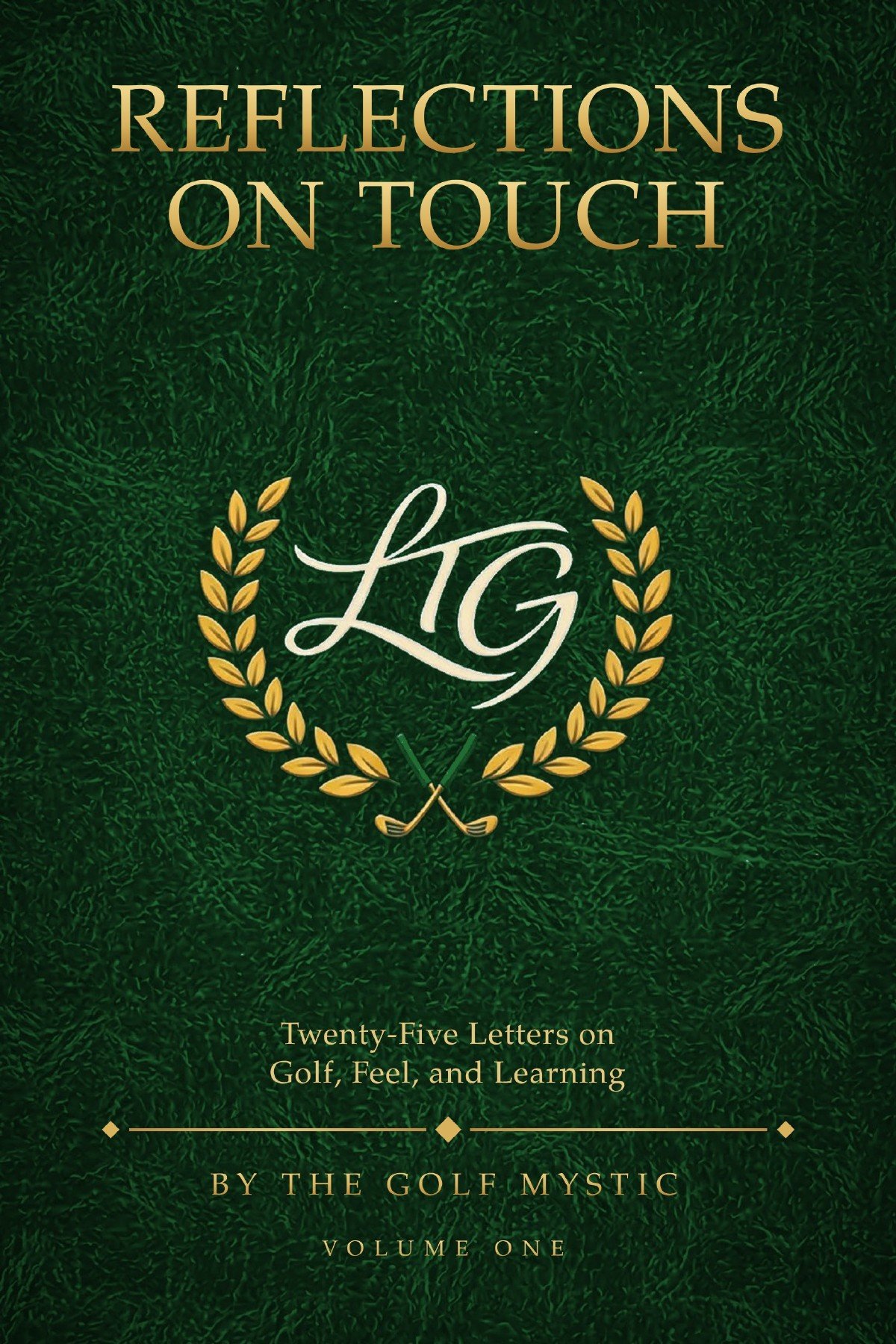
Reflections on Touch
Twenty-Five Letters on Golf, Feel, and Learning
A look inside: the opening of two letters from the collection.
From the Booklet
Your Hands Are Your Vision in Golf
Dear Friends,
One reason golfers have difficulty is that they rely so heavily on vision. The great assumption is that if you’re concentrating and looking hard at the ball, you should strike it well with the club. It seems logical. But it is not true. Concentrating on a golf ball with your keen eyes is exactly how you lose your sight in golf. You become blind — blind to your swing. Your hands tap into the feeling brain, not your eyes. Your hands are your vision in golf. Ergo, why our lessons are a lot of Eye-Clo.
Yes, the eyes ultimately supplement your hands, but in touch golf, they are not your primary source for developing a better swing and better ball striking. The primary focus needs to be on the club through the hands. The reason? Unlike tennis, baseball, or virtually all other stick-and-ball sports, the golf ball is not moving. In tennis, you track a moving ball with your vision. That makes sense; you’re constantly responding to the moving ball. In golf, you know where the ball is all the time. Besides, the ball contact is such a small part of a swing. There is so much more to a swing than just the instant of impact. So much more to enjoy and feel.
So, how do we develop a complete, effective swing? One, you need to feel a rhythm pattern. A pattern that is smooth and consistent in tempo. Daa Daaa Da. Then create a travel path with energy. Using a Pathfinder will do that. Match that travel path to the target, and then match the whirling clubface to the ground and target as well. So that’s flow, path, and timing. The three pillars of touch golf. Do you think concentrating on the ball will get you those qualities? I’m sorry, but no — you need to go through that process daily for about 20 minutes. In about three weeks, you will know your swing by feel, and it will be effective. The reward? You will have developed a touch swing. And that lasts for a lifetime!
…the letter continues in the booklet.
From the Booklet
The Simplest Exercise in Golf
Dear Friends,
There is one way to instantly elevate your awareness. I’ve talked about it before, and it’s so simple that most golfers would rather bypass it for more meaty instruction. But they would be missing out as they travel down the slippery slope of complexity. The simplest and most effective exercise you can learn is to swing the club with your eyes shut, from putting to driving.
Allow me to provide some background on the neuro side of this strategy and explain what makes it so effective. Closing your eyes gives a golfer three instant advantages. One, it suppresses interference arising from the visual low road. Two, it suppresses explicit reinvestment into the automatic, implicit motor program. And three, it literally forces a golfer to feel, not think.
So what is the visual low road? That is a term coined by neuroscientist Joseph LeDoux to describe a fast, direct route that carries what the eyes see to the amygdala, the brain’s center for fear, threat conditioning, and emotional memory. It evolved as a survival mechanism for rapid reaction to threats. It literally bypasses the visual cortex to trigger instant recognition of a threat. Simply put, when your eyes are closed during a swing, the fear response is reduced. And in golf, we know that is a great advantage.
…the letter continues in the booklet.
The Complete Collection
Reflections on Touch
All twenty-five letters, with references. A digital booklet for $19.99.